Introduction
In every Pediatric Intensive Care Unit (PICU), consultants carry the ultimate responsibility for patient care. Their clinical judgment, leadership, and supervision guide some of the most complex decisions in pediatric medicine. However, an equally important responsibility often receives less attention: PICU consultants teaching as part of their daily role.
As healthcare systems become increasingly busy, structured teaching by consultants may gradually decline, with education becoming largely dependent on bedside discussions, senior fellows, or self-directed learning. While these approaches are valuable, they should complement – not replace – the active participation of PICU consultants teaching in formal educational activities.
The question is therefore worth asking: Should PICU consultants continue delivering lectures, case discussions, and virtual educational sessions in addition to supervising clinical care?
Current educational evidence and international training standards strongly support the answer: yes.
Supervision and Teaching Are Different Responsibilities
Clinical supervision and education are closely related but fundamentally different.
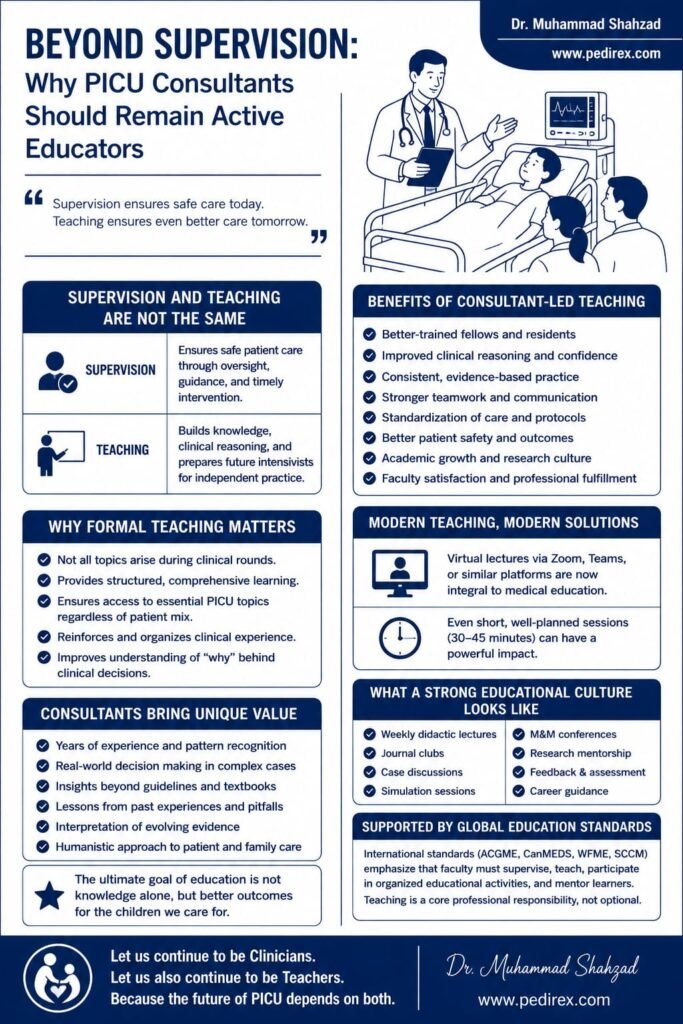
Supervision focuses on ensuring safe patient care by reviewing clinical decisions, providing oversight, and intervening when necessary. Teaching, on the other hand, aims to develop independent clinical reasoning, deepen medical knowledge, and prepare future intensivists for autonomous practice.
A fellow may learn what decision was made during rounds through supervision. Still, a structured teaching session allows them to understand why that decision was made, the physiology behind it, alternative approaches, and the latest evidence supporting clinical practice.
One cannot fully replace the other.
International accreditation standards such as those of the Accreditation Council for Graduate Medical Education (ACGME) identify faculty responsibilities as including supervision, teaching, participation in organized educational conferences, feedback, and mentorship rather than supervision alone (ACGME Common Program Requirements).
Why Formal Teaching Still Matters
Bedside teaching remains one of the most valuable methods of clinical education. It provides real-time learning, immediate feedback, and practical application of knowledge.
However, bedside teaching also has limitations.
Clinical rounds are often interrupted by emergencies, procedures, family discussions, admissions, and administrative responsibilities. Educational opportunities depend heavily on the patients currently admitted to the unit. Consequently, important topics such as extracorporeal membrane oxygenation (ECMO), pediatric ventilator physiology, difficult airway management, renal replacement therapy, sedation strategies, quality improvement, and research methodology may not be covered systematically.
Formal lecture, whether delivered in a conference room or through Zoom or Microsoft Teams provide a structured curriculum that ensures every trainee receives comprehensive exposure to essential critical care concepts regardless of patient census or case mix.
Rather than competing with bedside teaching, formal sessions reinforce and organize clinical experience.
Consultants Bring Unique Educational Value
Every experienced consultant accumulates knowledge that extends beyond textbooks and guidelines.
Years of managing critically ill children develop pattern recognition, clinical judgment under uncertainty, communication strategies with families, and practical decision-making that cannot easily be captured in written protocols.
When consultants share these experiences during formal teaching sessions, they help trainees develop clinical reasoning that would otherwise require many years to acquire independently.
Importantly, these discussions often include:
- Decision-making in complex or ambiguous cases
- Common diagnostic pitfalls
- Management of rare but life-threatening conditions
- Lessons learned from previous clinical experiences
- Interpretation of evolving evidence
- Balancing guidelines with individualized patient care
These insights represent one of the greatest educational assets within any academic PICU.
Virtual Teaching Is Now Part of Modern Medical Education
The rapid expansion of digital learning has transformed postgraduate medical education.
Today, educational conferences delivered through Zoom, Microsoft Teams, or similar platforms are widely accepted components of fellowship programs. These virtual sessions enable consultants to teach despite demanding clinical schedules, facilitate multidisciplinary participation, and allow fellows rotating at different sites to attend consistently.
Importantly, the educational value lies not in the platform itself but in the quality of the teaching.
A well-designed virtual lecture with clinical cases, interactive questions, and evidence-based discussion can be as effective as traditional classroom teaching when appropriately planned.
Modern educators are therefore no longer limited by geography or conference rooms.
Teaching Benefits Consultants as Well
Teaching is often viewed as a responsibility toward trainees, but it also benefits faculty members themselves. Preparing a lecture encourages consultants to:
- Review current literature
- Update clinical practice according to new guidelines
- Revisit physiological concepts
- Critically evaluate their own management strategies
- Standardize practice across the department
Many experienced clinicians acknowledge that preparing to teach is one of the most effective methods for maintaining lifelong learning.
As the old educational principle states:
“To teach is to learn twice.”
Although this phrase predates modern medical education, contemporary educational research consistently supports the concept that teaching reinforces knowledge retention and promotes reflective clinical practice.
Building a Culture of Learning
Strong fellowship programs are characterized not merely by excellent patient outcomes but by a culture in which education is valued alongside clinical service.
This culture is created when consultants actively participate in:
- Weekly didactic lectures
- Journal clubs
- Case-based discussions
- Morbidity and mortality conferences
- Simulation sessions
- Research mentorship
- Career guidance
- Feedback and assessment
Importantly, this responsibility should not rest on a single consultant. Educational leadership is most sustainable when teaching responsibilities are distributed across the faculty according to each consultant’s expertise and interests.
Such shared ownership enriches the curriculum while reducing the burden on individual educators.
Addressing Common Challenges
The greatest obstacle to consultant-led teaching is often time.
Busy PICUs face increasing clinical demands, staffing shortages, administrative responsibilities, and research commitments. These realities are genuine and should not be underestimated.
However, educational excellence does not necessarily require lengthy lectures every week.
Even one structured 30–45-minute consultant-led session every few weeks, supplemented by bedside teaching, journal clubs, and fellow presentations, can significantly strengthen a fellowship curriculum.
The goal is consistency rather than volume.
Technology also makes participation easier than ever. Consultants can deliver sessions remotely when clinical responsibilities prevent physical attendance, ensuring educational continuity without compromising patient care.
The Ultimate Beneficiary Is the Patient
The purpose of consultant-led teaching is not simply to fulfill academic obligations.
Its goal is safer, higher-quality patient care.
Well-trained fellows make better clinical decisions, recognize deterioration earlier, communicate more effectively, and practice more consistently with evidence-based guidelines.
Education therefore becomes an investment that extends far beyond the classroom.
Every lecture delivered today has the potential to influence hundreds of critically ill children cared for by tomorrow’s independent intensivists.
Conclusion
The role of a PICU consultant extends beyond supervising clinical care. International educational standards consistently recognize consultants as clinicians, supervisors, mentors, and educators.
Formal teaching – whether conducted in person or through virtual platforms such as Zoom or Microsoft Teams – should be viewed not as an optional academic activity but as an essential component of high-quality fellowship training.
Supervision ensures that today’s patients receive safe care.
Teaching ensures that tomorrow’s patients receive even better care.
The strongest PICUs are not only places where critically ill children recover – they are environments where future pediatric intensivists are intentionally developed through the combined efforts of experienced consultants who continue to share their knowledge, experience, and passion for lifelong learning.
References
- Accreditation Council for Graduate Medical Education (ACGME). Common Program Requirements (Residency and Fellowship). https://www.acgme.org
- Peters M, ten Cate O. Bedside teaching in medical education: a literature review. Perspect Med Educ. 2014;3(2):76–88.
- Carlos WG, et al. Teaching at the Bedside: Maximal Impact in Minimal Time. Ann Am Thorac Soc. 2016;13(5):594–597.
- Almoosa KF, et al. Critical Care Education During Internal Medicine Residency: A National Survey. J Grad Med Educ. 2010;2(4):555–561.
- World Federation for Medical Education (WFME). Global Standards for Quality Improvement in Postgraduate Medical Education.
- Frank JR, Snell L, Sherbino J, eds. CanMEDS 2015 Physician Competency Framework. Royal College of Physicians and Surgeons of Canada.
- Society of Critical Care Medicine (SCCM). Educational Resources and Faculty Development. https://www.sccm.org