Many parents quietly ask the same painful question:
“Did my child’s learning stop after COVID?”
The answer is not simple. Learning did not completely stop, but for many children, it was interrupted, slowed, or weakened. Some children missed basic reading skills. Some lost confidence in math. Some became more attached to screens. Others returned to school but struggled with attention, motivation, sleep, anxiety, or social skills.
This is not a failure of the child. It is not a failure of the parent. It is the result of a historic disruption in childhood, school routines, family life, and emotional development.
At the peak of the COVID-19 pandemic, school closures affected more than 1.6 billion students and young people worldwide, and global education recovery is still ongoing. UNESCO notes that schools are open again. However, education systems are still assessing the damage and trying to recover lost learning.
2. What is Learning Loss?
Learning loss means that a child has not gained the expected skills for their age or grade. It may affect reading, writing, spelling, math, concentration, language, problem-solving, or confidence.
For example, a child may be in Grade 4 but reading like a younger child. Another child may know math facts but panic when solving word problems. A teenager may attend school but avoid studying because they feel overwhelmed.
Learning loss is not always obvious. Some children become quiet. Some become angry. Some say, “I hate school.” Some spend more time on screens because schoolwork feels too difficult.
3. Why Did COVID Affect Learning So Deeply?
Children learn best through routine, repetition, emotional safety, teacher feedback, movement, play, and peer interaction. During COVID, many of these were disrupted.
Online classes helped, but they could not fully replace school for every child. Some children had poor internet access. Some had limited devices. Some had working parents who could not supervise learning all day. Some children were too young to learn well through screens.
COVID also affected sleep, physical activity, social interaction, and mental health. These are not separate from education. A tired, anxious, lonely, or inactive child cannot learn at full capacity.
The World Bank has continued to emphasize learning recovery after pandemic school closures, including the need to rebuild systems so children can learn effectively again.
4. Which Children Were Most Affected?
Not every child was affected equally.
Children who were already struggling before COVID often fell further behind. Younger children missed early reading and number foundations. Children with ADHD, speech delay, autism, dyslexia, hearing problems, chronic illness, or family stress may have faced extra difficulty.
Children from disadvantaged families were also more vulnerable. OECD reports that the pandemic had a particularly strong impact on vulnerable and disadvantaged learners, and many education systems are still evaluating which recovery policies actually worked.
This is important because parents sometimes compare their child with others and feel ashamed. But recovery depends on many factors: age, school support, home environment, emotional health, previous learning level, and access to good teaching.
5. Signs Your Child May Still Be Struggling
Parents should watch for these signs:
- Your child avoids reading or says reading is boring
- Homework takes much longer than expected
- Your child cries, becomes angry, or shuts down during study time
- They forget lessons quickly
- They cannot explain what they learned at school
- They guess words instead of reading them
- They struggle with basic addition, subtraction, multiplication, and fractions
- They have poor sleep, low motivation, or school refusal
- They depend heavily on YouTube, AI tools, or copied answers
- Their teacher says they are “behind,” “not focused,” or “not participating”
One or two signs do not mean something serious. But if the pattern continues for weeks or months, it is worth taking action.
6. The First Step: Find the Real Level, Not the Grade Level
Many parents make one mistake: they push the child to study harder at the current grade level, even when the child has missing foundations from earlier years.
If a child cannot read fluently, more difficult comprehension work will only create frustration. If a child does not understand basic multiplication, advanced fractions will feel impossible.
UNICEF foundational learning work emphasizes five key recovery actions: reach every child, regularly assess learning level, prioritize fundamentals, improve instruction, and support psychosocial health and well-being.
For parents, this means: do not start with pressure. Start with assessment.
Ask the teacher:
- “What specific skills is my child missing?”
- “Is the problem reading, math, attention, language, or confidence?”
- “What should we practice first at home?”
- “Does my child need a formal assessment for learning difficulties?”
7. How Parents Can Help at Home
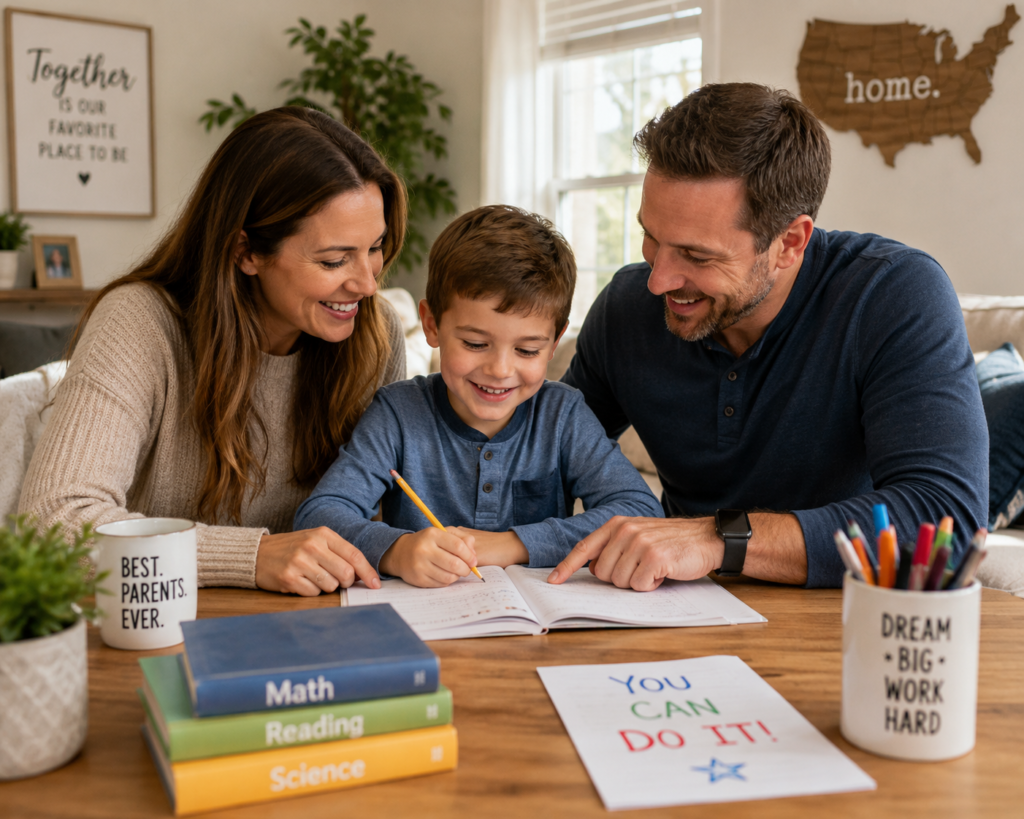
The goal is not to turn the home into another school. The goal is to rebuild learning gently and consistently.
Start with 20 minutes daily. Short, regular practice works better than long, emotional study sessions.
7.1 Help Reading Skills
Ask your child to read aloud every day. Choose books that are slightly easy, not humiliatingly difficult. Let them reread the same text to build fluency and confidence.
7.2 Rebuild Math Foundations
Go back to basics. Practice number sense, mental math, multiplication tables, and real-life examples like shopping, cooking, time, and money.
7.3 Improve Writing Gradually
Begin with small tasks: three sentences about the day, a short story, or a simple summary of a video or book.
7.4 Strengthen Memory
Use active recall. Instead of saying, “Read this again,” ask, “Tell me three things you remember.
7.5 Reduce Distractions
For attention, remove distractions. A quiet table, a visible clock, and one task at a time can help more than repeated scolding.
8. Do Not Ignore Sleep and Screens
Many children not only lost academic skills during COVID. They lost routine.
Poor sleep weakens Memory, mood, attention, and learning. Excessive screen time can reduce reading time, physical activity, and deep concentration.
A practical routine is powerful:
- Fixed sleep time
- Device-free meals
- Limited recreational screen use
- Daily movement
- Regular reading time
Children do not need perfect homes to recover. They need predictable homes.
9. When Should Parents Seek Help?
Speak with your child’s teacher, pediatrician, psychologist, or learning specialist if your child has:
- Persistent school refusal
- Severe anxiety
- Major reading delay
- Suspected dyslexia
- Attention problems
- Speech delay
- Regression
- Sadness
- Sleep disturbance
- A sudden decline in performance
Do not wait for the child to “grow out of it” if the gap is widening.
Early support is not labeling. It is protection.
10. Final Message for Parents
Learning after COVID may feel slower, but children can recover. The brain is adaptable. Skills can be rebuilt. Confidence can return.
The most helpful parent is not the one who pressures the child the most. It is the one who notices the difficulty, stays calm, asks the right questions, builds a routine, and gets help when needed.
So if your child is behind after COVID, remember this:
“Learning may have paused, but your child’s future did not.”
With patience, structure, good teaching, emotional support, and early action, many children can catch up, not all at once, but step by step.