Every evening, many homes enter the same battlefield.
The child is tired.
The parent is exhausted.
The Homework is waiting.
The screen is tempting.
And one simple sentence — “Please start your homework” — turns into tears, shouting, bargaining, or silence.
If this happens in your home, you are not alone. Homework battles are common. They do not always mean your child is lazy, spoiled, or careless. Often, they mean the child is overwhelmed, tired, distracted, hungry, anxious, or unsure how to begin.
A good learning routine at home is not about forcing children to study for hours. It is about creating a calm, predictable system that helps the child’s brain know:
- This is the time to focus
- This is the place to work
- I am not alone
2. Why Children Fight Homework
Before fixing the routine, parents need to understand the reason behind the resistance.
Children may fight Homework because they are mentally tired after School. Some children hold themselves together all day, then collapse emotionally at home. Others struggle because the work is too difficult, too boring, or too long.
Some children have weak executive function skills. These are the brain skills used for planning, starting tasks, staying focused, remembering instructions, and controlling impulses. Harvard Center on the Developing Child describes executive function and self-regulation as skills that help children manage information, make decisions, plan, and control behavior. These skills develop over time and improve with support and practice.
So, when a child says, “I don’t want to do it,” sometimes the deeper meaning is:
- “I don’t know where to start.”
- “This feels too hard.”
- “I am afraid I will fail.”
- “My brain is tired.”
- “I need help, but I do not know how to ask.”
This does not mean parents should ignore Homework. It means the solution should be structured, not shouting.
3. Start With a Soft Landing After School
Many children cannot move directly from School to Homework. Their brains need a transition.
A good after-school routine may look like this:
- Come home
- Eat a snack
- Drink water
- Rest for 20–30 minutes
- Move the body
- Then begin Homework
This short break is not wasted time. It helps children reset. Hunger, dehydration, and fatigue can make even a simple worksheet feel impossible.
For younger children, outdoor play or movement before Homework can improve cooperation. For older children, a short rest, shower, prayer, walk, or quiet time may help.
The key is to avoid the dangerous pattern:
School → Screen → Homework Fight
Once a child enters a fast-moving screen world, Homework feels slow and painful by comparison.
4. Choose a Fixed Homework Time
Children cooperate better when routines are predictable. A fixed time reduces negotiation.
Instead of asking every day, “When will you study?”, make the decision automatic:
- “Homework starts at 5:00.”
- “Reading starts after Maghrib.”
- “Math practice comes before screen time.”
- “The school bag is prepared before bedtime.”
Predictability reduces anxiety and arguments. It also helps the brain build habits.
This does not mean the routine must be rigid every day. Family life is not perfect. But the general pattern should be clear enough that the child knows what to expect.
5. Create a Simple Learning Space
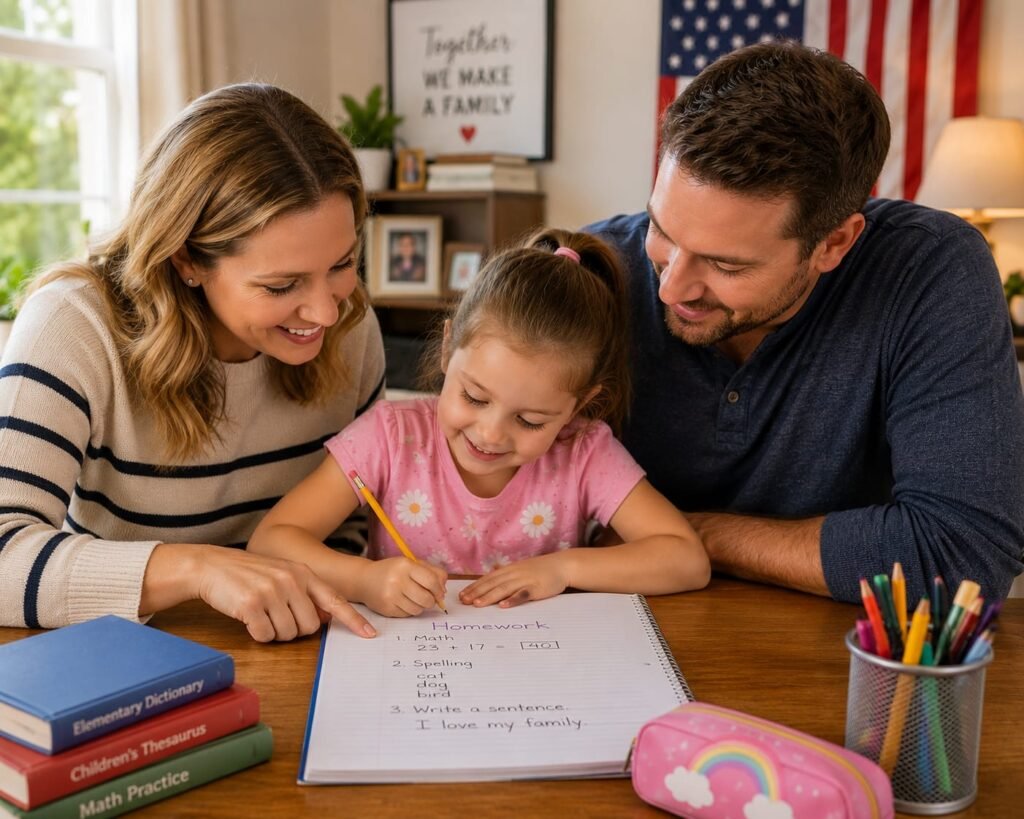
A child does not need an expensive study room. They need a consistent place with fewer distractions.
The best learning space has:
- A clear table
- Good lighting
- A comfortable chair
- Water nearby
- Only the needed books and pencils
- No television in the background
- No mobile phone beside the Homework
The American Academy of Pediatrics recommends screen-free zones, such as during Homework and before bed. It encourages families to reduce digital distractions by using rules such as “one screen at a time” and turning off autoplay and notifications.
This matters because children are not simply “bad at focusing.” Many are trying to focus in an environment designed to steal their attention.
6. Use the “Small Start” Method
The hardest part of Homework is often starting.
Do not begin with:
“Finish all your homework now.”
Begin with:
- “Let us do the first five minutes.”
- “Start with three questions.”
- “Read one paragraph.”
- “Write the date and title first.”
A small start reduces emotional resistance. Once the child begins, the brain often settles.
For children who get overwhelmed easily, use a timer:
- 10 minutes work
- 2 minutes break
- 10 minutes of work again
Younger children may need shorter blocks. Teenagers may manage longer periods. The goal is not to race. The goal is to build tolerance for focused work.
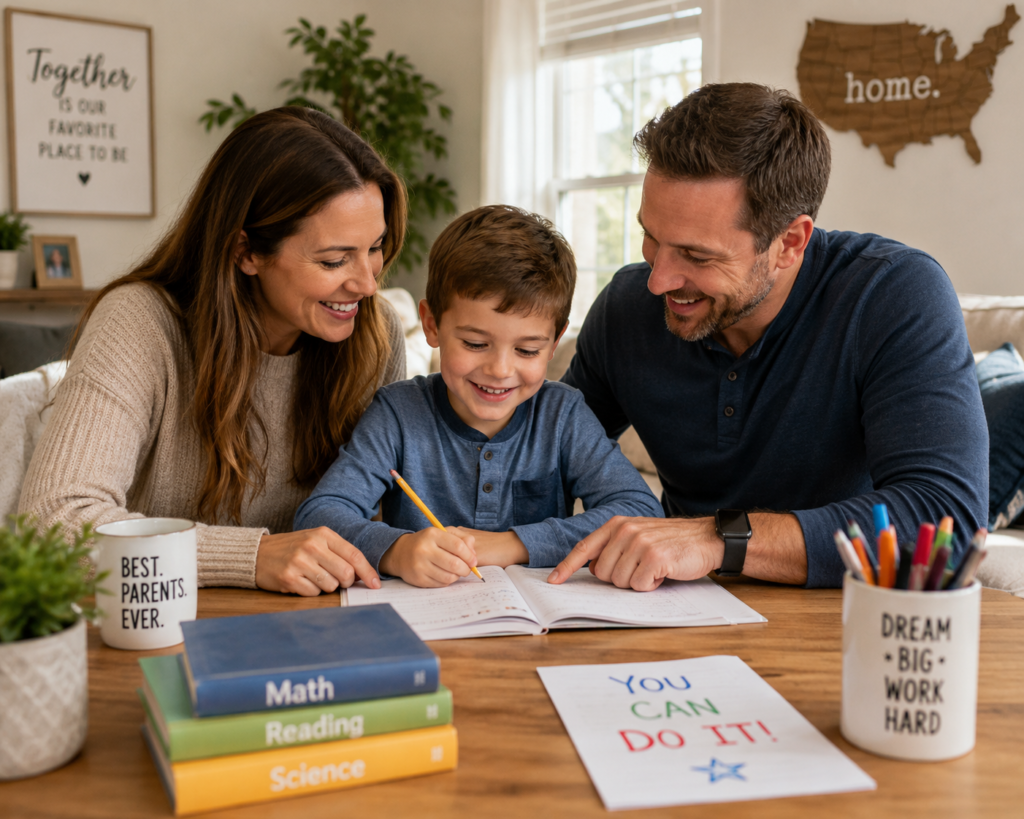
7. Stay Nearby, But Do Not Take Over
Children need support, but they also need independence.
For younger children, sit nearby and guide the beginning. For older children, check the plan first, then return later.
Try saying:
- “Show me what you have to do.”
- “What part looks easy?”
- “What part looks confusing?”
- “Let us start with the first question together.”
- “Now you try the next one.”
Avoid doing the Homework for the child. If parents rescue too quickly, children may become dependent. If parents leave too quickly, children may feel abandoned.
The balance is:
Support the process, not replace the effort.
8. Keep Screens Under Control
Screens are one of the biggest reasons evening routines fail.
This does not mean all screens are harmful. But recreational screen use before Homework often makes learning harder. Fast videos, games, notifications, and social media can make reading, writing, and math feel boring.
The American Academy of Pediatrics no longer recommends a single screen-time limit for all older children. Instead, it encourages families to focus on healthy media habits, context, content, sleep, relationships, and balance.
A practical family rule is:
Homework first, screens later.
Also consider:
- No phone during Homework
- No television in the study area
- No screens one hour before sleep when possible
- No devices in the bedroom overnight
These rules are not punishment. They protect sleep, attention, and emotional regulation.
9. Protect Sleep Like a Learning Tool
Sleep is not separate from education. It is one of the brain’s most important learning tools.
During sleep, the brain strengthens memory, processes emotions, and prepares attention for the next day. According to CDC guidance:
- School-age children (6–12 years) generally need 9–12 hours of sleep
- Teenagers (13–18 years) need 8–10 hours per 24 hours
A child who sleeps too little may look lazy, moody, careless, or forgetful. But the real problem may be exhaustion.
A good evening learning routine should end early enough to allow sleep. Studying late at night with tears is rarely effective.
10. Praise Effort, Not Only Marks e
Children who are constantly judged by grades may avoid learning because they fear failure.
Instead of saying:
- “You are smart.”
- “You must get full marks.”
- “Why did you make this mistake?”
Try saying:
- “I like how you started, even though it was hard.”
- “You stayed focused for 15 minutes.”
- “This mistake shows us what to practice.”
- “You improved from yesterday.”
This builds confidence and resilience. Children learn better when they feel safe enough to make mistakes.
11. When Homework Battles May Need Extra Help
Sometimes routine is not enough. Parents should seek help if homework battles are severe, persistent, or associated with other warning signs.
These include:
- Reading far below grade level
- Extreme difficulty with math basics
- Daily crying or panic before Homework
- School refusal
- Frequent headaches or stomachaches before School
- Poor sleep
- Loss of interest
- Attention problems in both School and home
- Teacher concerns about learning delay
- Sudden decline in performance
In these situations, the child may need assessment for dyslexia, ADHD, anxiety, vision or hearing problems, sleep problems, or other learning difficulties.
Getting help early is not labeling the child. It is protecting the child.
12. A Simple Evening Routine That Works
Here is a realistic structure that many families can adapt:
12.1 After School
- Snack
- Water
- Rest
- Movement
12.2 Before Homework
- Bathroom
- Clear table
- No phone
12.3 Homework Start
Begin with the easiest task.
12.4 Work Blocks
- 10–25 minutes, depending on age
12.5 Breaks
- Short
- Calm
- No fast screens
12.6 Review
- Check the school bag
- Prepare tomorrow’s needs
12.7 Evening Wind-Down
- Family time
- Reading
- Sleep routine
The best routine is not the strictest one. It is the one your family can repeat.
13. Final Message for Parents
A peaceful learning routine is built slowly. Do not expect perfection in one week.
Start with one change:
- A fixed homework time
- A screen-free study space
- A short work block
- An earlier bedtime
Children do not need parents who shout louder. They need parents who can stay calm, set limits, notice difficulties, and guide them back to the task.
Homework should not destroy the relationship between parent and child.
With patience, structure, sleep, reduced distractions, and the right support, evenings can become calmer, and children can learn without daily fighting.